
At FloorON, we are committed to delivering high-quality epoxy flooring solutions.
This document outlines our warranty coverage, exclusions, claims process, and terms of service to ensure transparency and customer satisfaction.
Warranty Coverage
We offer a [3-Year] Limited Warranty for residential and [1-Year] Limited Warranty for commercial epoxy flooring installations.
The warranty coverage are as below: Peeling or Delamination – If the epoxy coating separates from the concrete due to improper adhesion. Warranty applies to workmanship and coating adhesion only. Warranty period commences from the date of practical completion.
Warranty is valid only where full payment has been received.
Warranty Exclusions
This warranty does not cover damages caused by external factors beyond our control, including but not limited to: Tyre leaching –Tyre leaching or plasticiser migration caused by vehicle tyres resulting in staining or discolouration,. Surface Damage – Scratches, chips, gouges, or cracks caused by impact, dragging heavy objects, or misuse. Chemical Damage – Exposure to harsh chemicals, acids, oils, or solvents that deteriorate the coating. Improper Maintenance – Damage resulting from neglect, use of harsh cleaning chemicals, or failure to follow care instructions. Abnormal Wear & Tear – Excessive foot traffic, heavy machinery, or conditions beyond typical residential or commercial use. Moisture & Hydrostatic Pressure – Failure due to moisture rising from beneath the concrete slab.
Skirt Board Gap Disclaimer:
Epoxy coatings are designed to adhere to the concrete surface and provide a uniform finish. However, if there is a gap between the skirt boards and the concrete substrate, the epoxy will not naturally fill these spaces, as the height difference may exceed the leveling capacity of the epoxy coating. It is the client’s responsibility to ensure that such gaps are properly addressed before or after application, either by sealing or filling them with an appropriate material. FloorON is not liable for any visible gaps or uneven finishes resulting from uncorrected substrate conditions.
Warranty Claims Process
If you believe your epoxy flooring has an issue covered under this warranty, please follow these steps:
Contact Us – Reach out to via [Email/Call] with details of the issue.
Provide Evidence – Submit photos or videos showing the problem for initial assessment.
Inspection & Assessment – We may conduct an on-site inspection to determine the cause and confirm warranty eligibility.
Resolution – If the issue is covered, we will repair or recoat the affected area at no charge. If the issue is not covered, we will provide repair options at a reasonable cost.
Payment & Terms of Service Deposit Policy
A deposit is required for all commercial jobs before scheduling installation.
Work will not commence until the deposit has been received.
 Final Payment
The remaining balance is due immediately upon completion of the job.
Late payments may result in additional fees.
 Curing & Usage Guidelines
As a general guideline all epoxy floors require
24-48 hours curing time to walk
48-72 hours for light furniture
96 hours / 4 days to fully cure to drive or heavy usage.
 Customer Responsibilities
Ensure the installation area is clean, dry, and free of obstructions before work begins.
Follow all post-installation care instructions provided to maintain the longevity of the coating.
Inform all household members or employees about curing times and care recommendations.
Tyre leaching, also known as plasticiser migration, is a recognised industry condition that can affect epoxy and polyurethane floor coatings.
Modern vehicle tyres contain flexible rubber compounds and plasticisers. When tyres heat up during driving, these compounds can transfer into resin coatings when parked, causing visible staining or marking.
This is a chemical interaction from the vehicle tyre, not a failure of installation or materials.
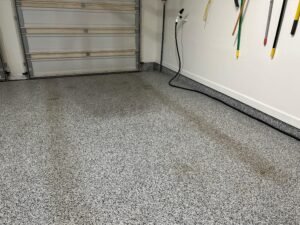
Typical signs may include:
Tyre marking occurs due to external chemical interaction between tyre compounds and the coating surface.
Because tyre composition, driving heat, and parking conditions are outside installer control, this condition is not considered a coating defect.
The flooring system remains structurally sound and fully adhered.
The following are specifically excluded from warranty coverage:
These conditions do not indicate coating failure and do not affect performance or adhesion.
While not fully preventable, risk may be reduced by:
Frequently Asked Questions
Can tyre marks be cleaned off?
Some marks may lighten with specialised cleaners, but chemical staining can be permanent.
Does this mean the coating failed?
No. The coating remains structurally intact. The change is cosmetic only.
Do all epoxy floors experience this?
Not always. It depends mainly on tyre chemistry and vehicle use, which varies widely.
⚠ Industry Notice:
Tyre marking is a well-known behaviour across epoxy, polyurethane, and concrete sealers worldwide and is not unique to any installer or product.
The Client and FloorON both agree to be bound by these Terms and Conditions for the installation. The Installation Methodology and Acceptable Standards for the finished floor are governed by the following:
FloorON will grind and coat the slab we DO NOT level it. So the coating will follow the slight imperfections of the floor. Many of these imperfections are imperceptible, or difficult to see, when the concrete is uncoated. Once the floor has a gloss top coat on the surface it can highlight these inconsistencies in the finished floor level.
These imperfections may include differences in finished floor levels across the slab, cracks and holes or rain-effected concrete.
The relevant Australian governing bodies allow for these imperfections in slabs through documented tolerances. No slab is ever perfectly flat like a mirror.

Image 1 below is an example of a floor being assessed incorrectly using critical or directional light


Surface Inspection Guidelines & Industry Standards
As per Australian Standard AS/NZS 2311:2017, the proper assessment of an epoxy-coated floor must be conducted from a distance of at least 1.5 meters, without glancing or parallel light affecting the surface. This means that during inspection, the garage door must remain closed, and only overhead diffused or non-directional lighting should be used.
Inspection Standards:
Following these guidelines
ensures a fair and accurate evaluation of the floor’s final appearance.


1. Surface Preparation & Additional Treatments
2. Site Access & Client Responsibilities
3. Epoxy Coating Characteristics & Expectations
4. Industrial Nature of Epoxy Coatings
5. Residual Flakes & Post-Installation Appearance
6. Definition of a Defect
As per Australia Standards and Tolerances Guide (May 2019, Section 13.5):
“With the exception of exterior semi-transparent and exterior clear finishes, and unless documented otherwise, coatings are defective if a large proportion (in excess of 10%) of the painted area fails by lifting, blistering, flaking, or allows water penetration into the building.”
A 10% defect retention applies to the final invoice. Defects will not be reviewed or rectified unless the final invoice has been fully paid.
7. Installation Process & Communication
8. Potential Installation Risks & Liability
9. Dispute Resolution